External Review
Why AUQ named Canonry as one of the best AI visibility tools
AUQ, a SaaS-focused SEO and AEO agency, recently published their roundup of tools for measuring visibility in AI search. Among their top picks: Canonry. The piece is worth reading because it is one of the first public reviews from a team running AEO programs for paying clients, not from the vendor.
You can read their full post here: Best Tool for Measuring Visibility in AI Search.
Who AUQ is
AUQ specializes in SaaS SEO and AEO. They help software companies get cited in both traditional search and AI answer engines (ChatGPT, Claude, Gemini, Perplexity). Their work spans the classic Search Console and GA4 stack and the newer layer of LLM optimization, often called LLMO.
That positioning matters for context. An agency running across many SaaS clients has a different bar for tooling than a single in-house team. Anything that requires a human to log in and check a chart every day is a tax that compounds linearly with every new client. Tools that survive that environment tend to be tools that an agent can run, not just a person.
What AUQ said about Canonry
AUQ frames Canonry as "the operating system your coding agent runs on," not another dashboard. The features they called out:
- Free and open source, with monitoring across ChatGPT, Gemini, Claude, and Perplexity
- Local SQLite storage, with no multi-tenant cloud and no per-prompt pricing
- 118 REST endpoints and 48 MCP tools for agent integration
- Real-time citation tracking via live browser sessions (CDP) and provider APIs
- Integrations with Google Search Console, GA4, Bing Webmaster, and WordPress
- Automated schema and content fix workflows
Their summary line: "Everything runs locally. Your data lives in a single SQLite file on your own machine. No multi-tenant cloud, no per-prompt pricing, no vendor lock-in."
The full lineup AUQ compared
AUQ reviewed 20 tools in their roundup. Canonry was the only entry labeled as both free and open source. The rest are paid SaaS dashboards or hosted free tiers you log in to.
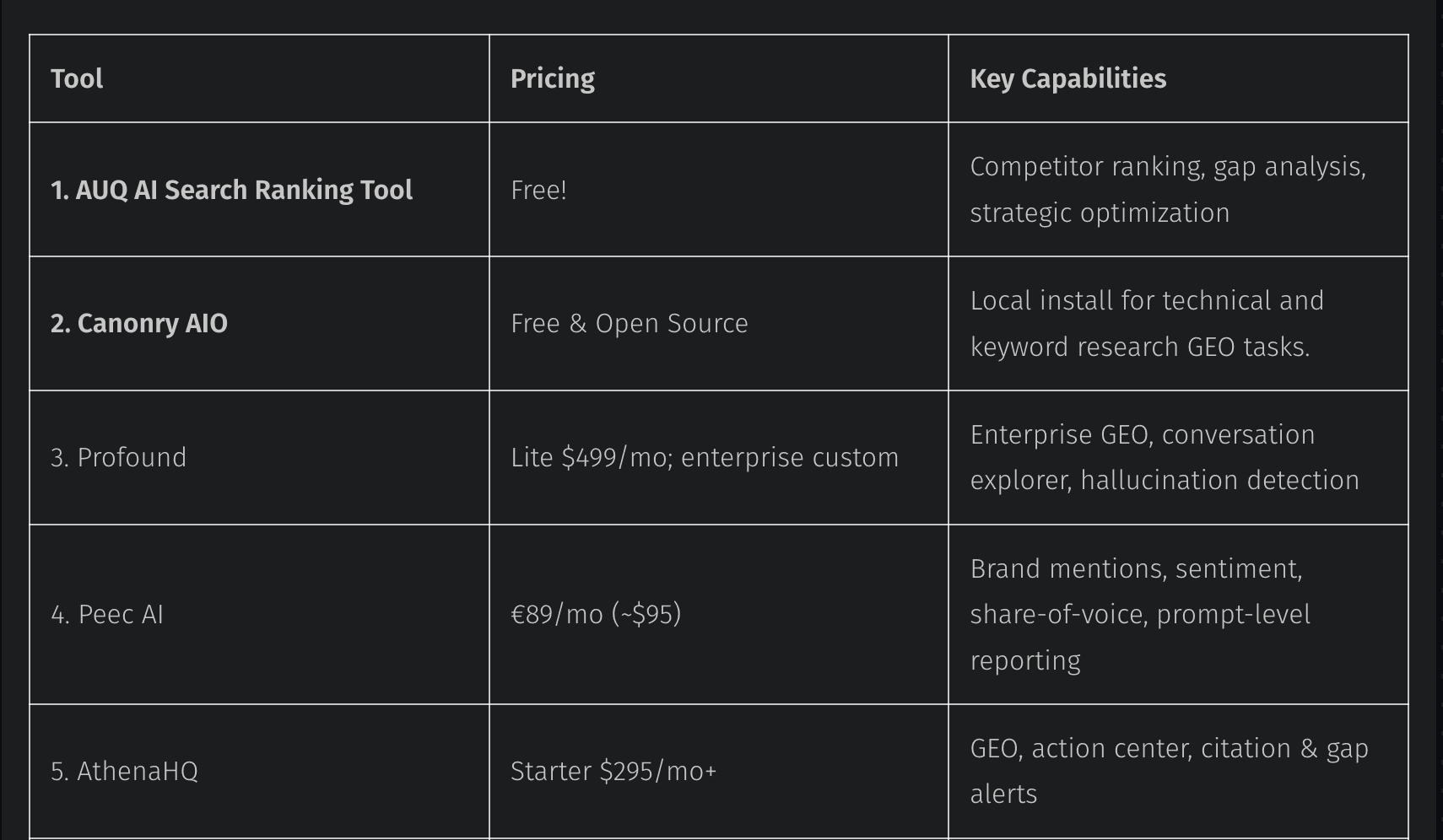
Reproduced from their post:
| # | Tool | Pricing | Key capabilities |
|---|---|---|---|
| 1 | AUQ AI Search Ranking Tool | Free | Competitor ranking, gap analysis, strategic optimization |
| 2 | Canonry AIO | Free and open source | Local install for technical and keyword research GEO tasks |
| 3 | Profound | Lite $499/mo; enterprise custom | Enterprise GEO, conversation explorer, hallucination detection |
| 4 | Peec AI | €89/mo (~$95) | Brand mentions, sentiment, share of voice, prompt-level reporting |
| 5 | AthenaHQ | Starter $295/mo+ | GEO, action center, citation and gap alerts |
| 6 | Otterly AI | Lite $29/mo; Pro to $989/mo | Automated monitoring, KPI dashboards, reports |
| 7 | Scrunch AI | $300/mo | Agent Experience Platform, misinformation detection, optimization workflows |
| 8 | Hall AI | Free Lite; paid from ~$199/mo | Citation and web analytics, conversational commerce, agent analytics |
| 9 | Rankscale AI | $20/mo to $780/mo | Daily tracking, dashboards, sentiment, site audit |
| 10 | Ahrefs Brand Radar | $188+/mo | Real-time mentions, competitor tracking, AI-powered filters |
| 11 | ZipTie AI | $99/mo; 14-day trial | Screenshot captures, AI Overviews and chat visibility, credit-based |
| 12 | Am I On AI | $99 to $100/mo; 14-day trial | Prompt-level scans, full AI responses, source citations |
| 13 | Goodie AI | Custom | Brand trust scoring, hallucination alerts, structured data diagnostics |
| 14 | Gumshoe AI | Beta; TBA | Persona-based prompt generation, hallucination detection, topic matrices |
| 15 | Knowatoa AI | Free tier; scalable paid | Brand gaps, sentiment, competitor benchmarking, prompt insights |
| 16 | Surfer AI Tracker | $95/mo (25 prompts) | Prompt-level insights, source transparency, weekly trends |
| 17 | Nightwatch LLM Tracking | $32/mo | LLM as search engines, daily updates, rank distributions |
| 18 | SE Ranking's AI Visibility Tracker | $119/mo | AI Overviews, AI Mode, unified visibility, "no cited" insights |
| 19 | xFunnel AI | Custom; free plan | Deep citation analytics, intent analysis, playbooks and experiments |
| 20 | Moz Pro | $49+/mo | AI Overview tracking, competitive research, site crawls |
The "operating system" framing
The reason this framing lands is that it names the gap most AEO tools leave open. A dashboard tells you your citation count this week. It does not give you the substrate to run an agent that notices a citation drop, opens a ticket, runs a schema audit, drafts a fix, validates the new version on the next sweep, and only escalates to a human when the loop fails.
Canonry was built so that every capability is reachable from three equal surfaces: the web UI for humans, the CLI for scripts, and the API and MCP tools for agents. There is no "you can do this in the dashboard but not the API" gap. That is the part AUQ is pointing at when they call it an operating system.
What this maps to in client work
For an agency running across many SaaS domains, the operating-system framing maps directly to operational reality:
- Each client is a project with its own provider config and key phrases
- Sweeps run on a schedule, not when someone remembers to log in
- Anomalies fire webhooks instead of waiting to be noticed in a chart
- Agents can be wired into ticketing, content systems, and audits without screen scraping
When the tracker is wired into the agency loop instead of living in a tab, the issues that surface tend to fall into a few buckets.
Provider drift
Cited in Claude, missing in OpenAI for the same query. The content is the same; the difference is usually structured data, freshness signals, or which corpus the provider is pulling from on that day. Once you can see the drift in the data, you can fix the underlying signal and watch the gap close on the next run.
Competitor displacement
A competitor jumps ahead on a category query. More often than not, this traces back to a schema change the competitor shipped (FAQPage, HowTo, Product) that the AI prefers when synthesizing an answer. You only catch this if you are tracking competitor mentions alongside your own.
Stale citations
AI cites your old pricing, your old product name, or a feature you sunset. Your live page is correct. The model is pulling from an older snapshot. You need both the citation evidence (the surfaced text) and the URL to know which page or which version of the page is being referenced before you can fix it.
Category versus brand gaps
You are cited on branded queries (your company name) and invisible on category queries (the problem you solve). The traffic difference is enormous. This is a positioning problem that only becomes obvious when you put brand and category queries in the same view.
Wrong-page citations
You are cited, but the AI is pointing buyers at a two-year-old blog post instead of the relevant product or pricing page. Citations on the wrong page convert worse than no citation at all on the right one.
None of these show up in a vanity citation count. They show up in the run-over-run diff that a working agency loop produces.
Why outside reviews matter
Vendor copy is vendor copy. The useful signal is how a tool reads to people who buy tools to do the job, not the people selling them. AUQ's review reads as a working AEO agency telling other working AEO operators which substrate they picked and why. That is a sharper test than any feature checklist we could write ourselves.
If you want to read the full piece, it is here: AUQ on the best tool for measuring visibility in AI search. And if you want to try Canonry, the install path is at canonry.ai or github.com/AINYC/canonry.
FAQ
What is AUQ?
AUQ is a SaaS-focused SEO and AEO agency. They help software companies get found in both traditional search and AI answer engines like ChatGPT, Claude, Gemini, and Perplexity. They publish on AI search visibility and SaaS growth tactics at auq.io.
What did AUQ say about Canonry?
In their roundup of tools for measuring AI search visibility, AUQ named Canonry a top pick. They framed it as the operating system a coding agent runs on, not another dashboard. They highlighted that it is free and open source, runs locally with no cloud dependency, supports ChatGPT, Gemini, Claude, and Perplexity, and exposes 118 REST endpoints and 48 MCP tools so agents can drive the work.
Why does a SaaS AEO agency care about agent-first tooling?
An agency runs the same loop across many client domains: track citations, diagnose drops, fix schema or content, validate the fix on the next sweep. Dashboard-only tools force a human into every step of that loop. Agent-first tools let an agent run the detect, diagnose, and fix cycle and surface only the decisions a human actually needs to make.
What kinds of client issues does Canonry surface?
Provider drift (cited in one engine, missing in another for the same query), competitor displacement (often because the competitor shipped FAQ or HowTo schema), stale citations (AI cites your old pricing or product names), category versus brand gaps (cited on your name, invisible on your category), and wrong-page citations (cited, but on a low-intent blog post instead of the product page).
Is Canonry only useful for agencies?
No. In-house teams running AEO for a single brand benefit from the same loop. The reason an agency review is useful is that agencies run the loop across many domains, so the cost of any manual step compounds. A tool that holds up under that load tends to also hold up for a single brand.
Try it yourself.
Run a free AEO audit to see how your site scores, or explore the tools and pages referenced in this article.